
Mount Speke | Hike Uganda’s Second Highest Peak in Rwenzori Mountains
Mount Speke | Hike Uganda’s Second Highest Peak in Rwenzori Mountains. Explore the Rwenzori Mountains of Uganda and learn more about Mount Speke, including its history, climbing routes, difficulty, wildlife, and trekking expedition details. As one of the highest points in the Rwenzori Mountains, Mount Speke attests to the region’s stunning scenery and intricate geology. The Rwenzori Range, sometimes called the Mountains of the Moon, is home to this mountain in Uganda. Mountaineers and ecotourists travel from far and wide to climb Mount Speke for its renowned difficult terrain, varied ecosystems, and stunning panoramas.
Mount Speke, in contrast to Mount Stanley’s Margherita Peak, is popular with hikers who are looking for a less demanding, more interesting, and adventurous climb. John Hanning Speke was one of several British explorers who helped find the source of the Nile River. The summit bears his name in his honour. Among the East African mountains, it continues to attract relatively few sightseers even now. It gives you the chance to escape from the crowds and enjoy nature.
An intricate network of tiny ridges, deep gullies, and high-altitude moorland connects Mount Speke’s cluster of pointy summits, giving the mountain its distinctive structure. Tops like Vittorio Emanuele, Ensonga, Johnson, and Trident Peak are prominent features of this mountain range. The route takes you through a variety of climate- and plant-rich ecosystems, including a montane forest, bamboo slopes, heather zone, marshy lowlands, and bare rock. The ethereal scenery that the Rwenzori are renowned for is crafted by Afro-alpine flora, moss-covered heather trees, lobelias, and giant groundsels.
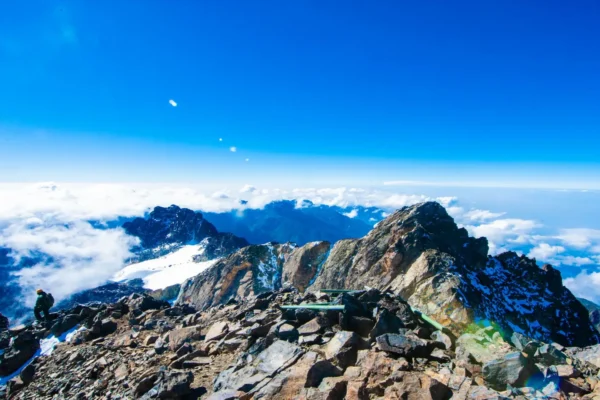
5-Day Mount Speke Trek
A 5-day Mount Speke trek in the Rwenzori Mountains (Uganda) is a challenging, high-altitude adventure targeting the 4,890m Vittorio Emanuele Peak, the second-highest summit in the range. The trek typically starts at Nyakalengija, passing through lush rainforests, bamboo zones, and challenging bogs to reach Bujuku Camp for the summit push.
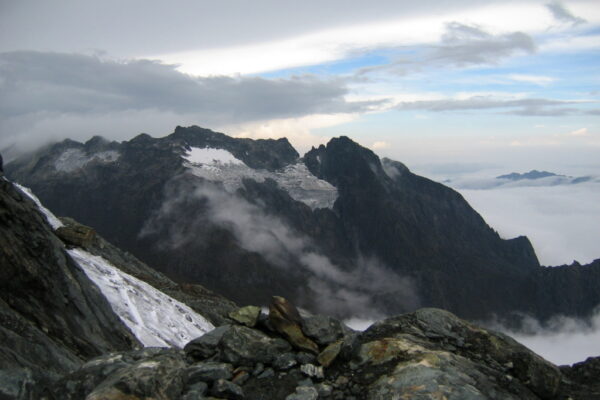
Mount Speke vs Mount Stanley
Mount Stanley (5,109m) and Mount Speke (4,890m) are both premier, glaciated peaks in Uganda’s Rwenzori Mountains, with Stanley being the highest and Speke the second highest. Mount Stanley (Margherita Peak) offers a more strenuous, technical climb with fixed ropes, while Mount Speke offers a shorter, less crowded, yet equally rugged adventure.
History of Mount Speke in the Rwenzori Mountains
A look into Mount Speke’s past reveals a complex web of local myths and colonial intrigue. Mount Speke is a noteworthy historical landmark because it was named for the British explorer John Hanning Speke, who is widely believed to have been the first European to reach Lake Victoria and to have postulated that it was the source of the Nile River.
Until the late 19th and early 20th centuries, the Rwenzori Mountains were mostly uncharted territory for Europeans. Mount Speke was one of several peaks climbed by the Italian mountaineer Duke of the Abruzzi in 1906 during the first documented journey to the Rwenzoris.
Location of Mount Speke
Located in western Uganda, close to the border with the Democratic Republic of the Congo, Mount Speke is part of the Rwenzori Mountains National Park, a UNESCO World Heritage Site. One of the six main peaks in the Rwenzori Range, which is around 120 kilometres long and 65 kilometres wide, is Mount Speke. One of the four tallest mountains in the Rwenzori range, Mount Speke stands 4,890 meters (16,043 feet) above sea level.
Geological Formation of Mount Speke
Mount Speke and the rest of the Rwenzori Mountains are geologically distinct. The Rwenzoris are block mountains, as opposed to the typical volcanoes that arise when tectonic plates collide. The East African Rift system is responsible for their formation, which involved the lifting of a section of the Earth’s crust. A varied and rough terrain defined by deep gorges, lofty peaks, and steep valleys has been shaped over millions of years by this geological activity.
Mount Speke, along with the remainder of the Rwenzori Range, is well-known for its abundant biodiversity. Because of the wide variation in elevation, the area is home to a wide variety of plant and animal species in their own special biological zones. Rwenzori turacos and other birds, as well as blue monkeys and Rwenzori colobus monkeys, call the forest zone at lower elevations home. The landscape transforms from bamboo forests to heather zones dominated by groundsels and enormous lobelias as one ascends. Vegetation in the higher alpine zone is scant because the hardy plants there have adapted to the harsh circumstances. To the ecological significance and natural legacy of the Rwenzori Mountains, Mount Speke’s biodiversity is a major contributor.
The cultural and ecological importance of Mount Speke cannot be overstated. From an ecological perspective, it provides a home to a wide variety of species, including several that are unique to the Rwenzori Mountains. Due to its rich biodiversity, it is an essential region to protect. The Bakonzo people hold the Rwenzoris, particularly Mount Speke, in high regard since they think the mountains are where their deities reside. The surrounding landscapes and the peaks are steeped in local folklore and traditions, which make them an essential element of the cultural environment.