
Mount Stanley | Hike Uganda’s Highest Peak in Rwenzori Mountains
The Democratic Republic of the Congo and Uganda both lay claim to Mount Stanley as their highest point. Also, after Kilimanjaro and Mount Kenya, it is the third-highest mountain in Africa. It stands at an impressive height of 5,109 meters (16,763 ft). One of the UNESCO World Heritage Sites in Rwanda is the Rwenzori Mountains National Park, which includes Mount Stanley. The alpine trekking experience it offers is unparalleled on the continent.
The name “Stanley” was bestowed upon this mountain range by the early explorer Sir Henry Morton Stanley. Among its numerous peaks are eleven glacial summits, the most famous of which is Margherita Peak, the holy grail for travellers who dare to confront the frigid climate of Uganda.
Hiking to Margherita Peak on Mount Stanley
Elena Hut is the starting point for the ascent to Margherita Peak, which involves navigating the Stanley Plateau and ascending high ice walls, rock scrambles, and glacial crevasses. No one should attempt to cross icy or snowy terrain without a rope, especially in light of the following UWA upgrades:
- A newly constructed bridge over a deep crevasse
- Additional fixed climbing ropes
- Constant trail safety monitoring
Note: While Margherita is the main goal, the Alexandra, Albert, Cheptegei and Savoia Peaks are also accessible for mountaineers seeking extended summit challenges
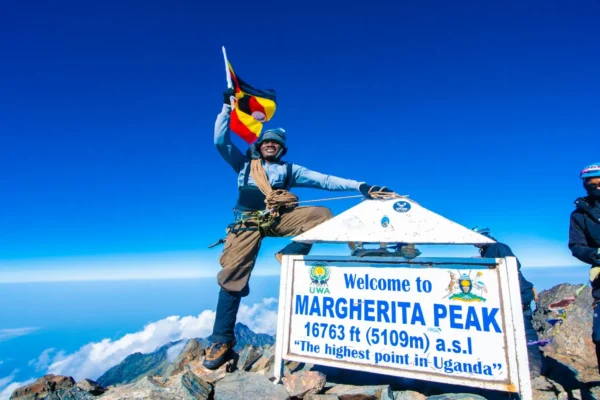
8-Day Kilembe Rwenzori Trekking
The 8-day Kilembe Rwenzori Trek is a challenging, scenic trek to Margherita Peak (5,109m) in Uganda, operated by Rwenzori Trekking Services. It starts at 1,450m and ascends through diverse zones (bamboo, heather, alpine) via Sine, Mutinda, and Bugata camps to Margherita Camp, with a challenging glacier climb on Day 6.
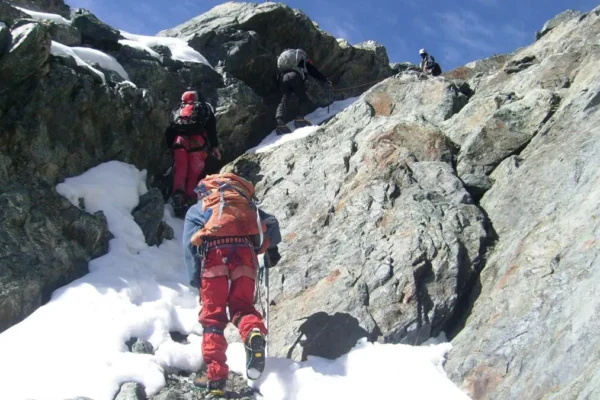
Mount Stanley & Baker
Mount Stanley (5,109m) and Mount Baker (4,844m) are iconic peaks in Uganda’s Rwenzori Mountains, often climbed together on 8–10 day treks to experience glaciers near the Equator. Mount Stanley’s Margherita Peak is Uganda’s highest point, offering technical, high-altitude climbing, while Baker offers dramatic, steep terrain, both featuring incredible scenery.
7-Day Rwenzori Kilembe Trekking
The 7-day Rwenzori trek via the Kilembe Trail (Southern Circuit) is a challenging mountaineering expedition in Uganda’s Rwenzori Mountains National Park. Managed by Rwenzori Trekking Services, this route is known for its scenic beauty and comfortable hut accommodations.
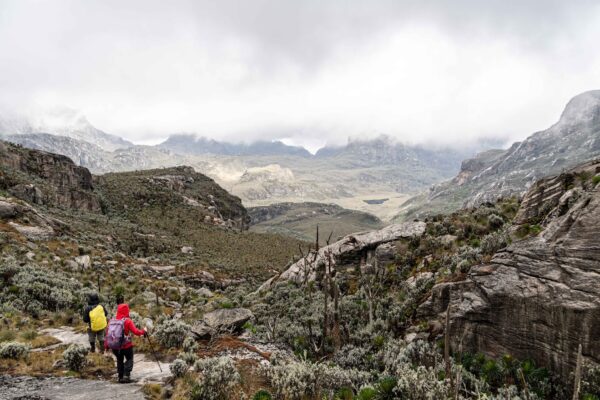
5-Day Rwenzori Margherita Peak
A 5-day trek to Margherita Peak (5,109m) in the Rwenzori Mountains is an intense, high-altitude expedition designed for fit, experienced climbers, typically following the Central Circuit via Nyakalengija. This accelerated itinerary requires long daily hiking hours and steep climbs, involving traversing glaciers and traversing boggy areas.
4 Popular Peaks of Mount Stanley, Rwenzori Mountains
1. Magherita Peak (5,109 m)
Margherita Peak, the highest summit of Mount Stanley at 5,109 meters above sea level, is named after the Italian queen Margherita. The first climb of the Rwenzori Mountains was accomplished in 1906 by the daring Duke Luigi Amedeo of Abruzzi, a master mountaineer and explorer. Famous features of Margherita Peak include towering cliffs, snow-capped glaciers topped with enormous rocks, and an elevation that gives the impression that the peak reaches for the sky.
2. Cheptegei Peak (4,907 m)
The Moebius Peak, formerly known as Cheptegei Peak, is situated atop Mount Stanley. Cheptegei Joshua, whose remarkable feats have just earned gold medals for Uganda, is named after the mountain.
The Congo and Ugandan lowlands, as well as the Alexandra, Margherita, and Stanley glaciers, may be seen from this vantage point. Avoiding the Margherita glacier in favour of traversing the Stanley glacier allows us to reach Cheptegei, a mountain measuring 4907 meters, and other peaks.
3. Alexandra Peak (5,091 m)
Alexandra Summit, a prominent peak on Mount Stanley in the Rwenzori Mountains that border Uganda and the Democratic Republic of the Congo (DRC), reaches an elevation of 5,091 meters (16,703 feet). This is the lesser of the two summits that make up Mount Stanley; the other, Margherita Peak, is 5,109 meters taller. A lot of people make the long climb to the top of the glacier so they can see the Rwenzori Mountains. After Prince Alexander of Belgium, the first climb of Alexander Peak was made in 1906 by the Duke of Abruzzi. If you’re seeking a less challenging hike, you might want to consider climbing Alexander Peak instead of Margherita. The top is considerably simpler.
4. Albert Peak (5,087 m)
King Albert I of Belgium was a staunch advocate for collecting data and doing research on East Africa, and it was in his honour that Albert Peak was named. In an effort to decipher the secrets of the Rwenzori Mountains, he helped finance explorations there. The 5,087-meter (16,690-foot) summit, situated on the Stanley Plateau, is a favourite among adventurers for its stunning landscapes and unusual rock formations.
Albert Peak, in the DRC, is a subsidiary summit of Mount Stanley. Mount Stanley is the tallest mountain in both Uganda and the DRC, and it ranks third among African summits, behind Kilimanjaro and Mount Kenya. Albert Peak is located in the Democratic Republic of the Congo.
Why Trek Mount Stanley?
Climbing Margherita Peak, the highest point of Mount Stanley, is an exciting and difficult mountaineering trip for a number of reasons. Trekking Mount Stanley is a great option for those who are looking for an exciting adventure, a difficult climbing task, and the chance to witness a stunningly beautiful and ecologically rich mountain range.
Third Highest Peak in Africa: Margherita Peak is not only the highest point in Uganda, but it is also the third-highest mountain in Africa, following Mount Kilimanjaro and Mount Kenya. The elevation is 5,109 meters, or 16,762 feet. For every mountaineer, reaching the peak is a huge achievement.
“Mountains of the Moon Mystique: Mount Stanley, a mysterious peak in the Rwenzori Mountains, is sometimes called the “Mountains of the Moon.” This ancient mountain has an aura of mystery due to the fact that snow and mist often cover it, even though it is located in the tropical region. This surreal setting is further accentuated by giant lobelias and other strange Afro-alpine plants.
Technical Challenge: Although Mount Stanley is not as high as Kilimanjaro, it is known to be more challenging to reach the peak of. Along the way, you’ll see bogs, challenging terrain, ice cliffs, and glaciers like Margherita and Stanley. While prior high-altitude trekking experience is helpful, you’ll still need to be in decent physical condition to finish. Additionally, technical gear like crampons and ropes is often necessary.
Stunning and Diverse Landscapes: Beginning at lower levels in the midst of bamboo forests and tropical rainforests, the trail winds its way through heather zones and alpine meadows before reaching the frigid peaks. You will be greeted by breathtaking views of towering mountains, gushing waterfalls, beautiful alpine lakes (such Lake Bujuku and Lake Kitandara), and rough valleys.
Unique Biodiversity: A vast array of plant and animal species call the Rwenzori Mountains, a World Heritage Site designated by UNESCO, home. Unique flora and fauna include the Rwenzori turaco, black and white colobus monkeys, and other bird species. Groundsels and huge lobelias are examples of fascinating and unique plants.
Less Crowded than Other African Mountains: Compared to other African mountains, this one is rather uncrowded. Climbing Mount Stanley offers a more genuine and isolated chance to be one with nature than the more popular Kilimanjaro and Mount Kenya approaches.
Opportunities for multi-peak expeditions: There are numerous other stunning peaks in the Rwenzori range besides Mount Baker and Mount Speke; in fact, there are routes that enable you to summit multiple peaks in a day. Because of this, the walk is both more difficult and more rewarding.
Cultural Experience: People from the surrounding area, like the Bakonzo, often approach hikers and offer to show them around and help them carry their gear. While you walk, they will share their culture and daily routines with you.